 By Admin
The biggest battery storage news in 2026 is no longer about whether the technology can support modern power grids. It is about how quickly developers can build it, connect it, finance it, and operate it safely.
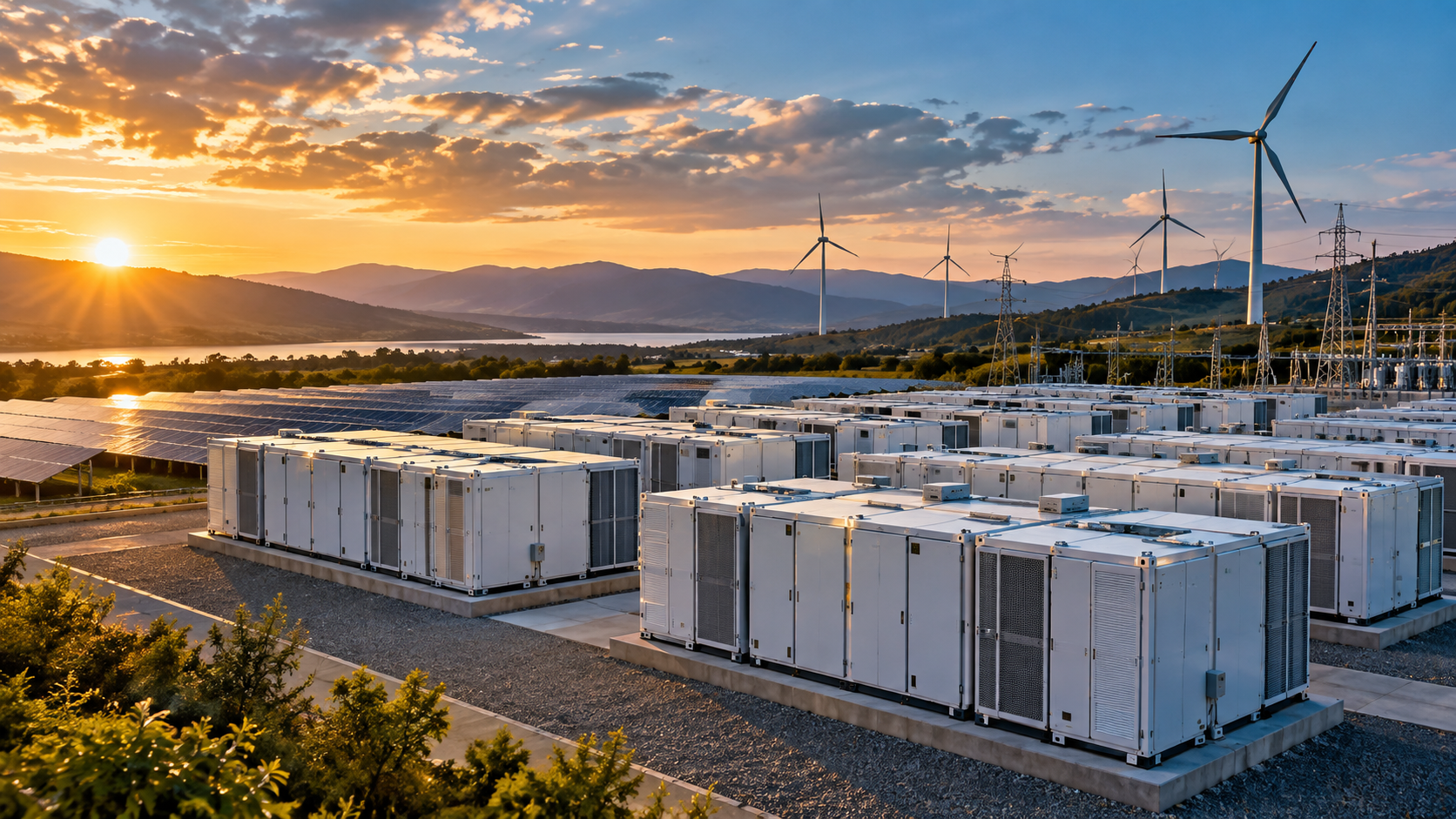
Battery installations are expanding alongside solar and wind, but the market is also being pulled forward by rising electricity demand, grid congestion, extreme weather, and data centers. The result is a rapid shift from small pilot projects to utility-scale battery energy storage systems, often measured in hundreds of megawatts and capable of delivering power for several hours.
Battery Storage News Shows a Market Moving Into the Mainstream
Global battery storage installations increased by 43% in 2025, according to Wood Mackenzie figures reported by Reuters. The same outlook projects average annual growth of 10.8% from 2024 through 2034. Average project costs had fallen to about $125 per kilowatt-hour by December 2025, although prices still vary widely by country, project duration, equipment source, grid connection, and construction requirements. Reuters
This momentum reflects a basic need. Solar panels produce most strongly during daylight hours, while electricity demand often peaks later. Wind output can also change quickly. Battery energy storage systems (BESS) charge when electricity is abundant or inexpensive and discharge when the grid needs additional power.
That makes storage useful for more than shifting renewable electricity from one part of the day to another. Batteries can provide frequency regulation, voltage support, reserve capacity, congestion relief, backup power, and fast response during sudden changes in supply or demand.
U.S. Battery Storage Capacity Continues to Break Records
The United States remains one of the world’s most active grid-scale battery storage markets. U.S. utility-scale capacity reached 43.6 gigawatts at the end of 2025. Operators added another 8.3 GW during the first half of 2026, taking the total to nearly 52 GW. Developers reported plans for a further 14 GW in the second half of the year and 54 GW over the following two and a half years. U.S. Energy Information Administration
Texas, California, and Arizona remain central to this expansion. These states combine large solar or wind fleets with high electricity demand, active wholesale markets, and a growing need for flexible capacity. The U.S. Energy Information Administration estimated at the beginning of 2026 that batteries could represent 28% of all planned utility-scale capacity additions during the year. U.S. Energy Information Administration
The numbers also show why MW and MWh should not be treated as interchangeable:
- Megawatts (MW) describe how much power a battery can deliver at one moment.
- Megawatt-hours (MWh) describe how much energy it can store.
- A 100 MW/400 MWh system can theoretically discharge at full power for four hours.
Four-hour systems remain common, but developers are increasingly examining longer-duration projects as grids add more renewable generation and face longer periods of tight supply.
Europe Is Shifting Toward Larger Utility-Scale Projects
Europe’s storage market is also changing shape. The wider European region installed 36 GWh of new battery storage in 2025, 48% more than in 2024. SolarPower Europe expects annual installations to reach 138 GWh by 2030, with utility-scale projects accounting for roughly three-quarters of the annual market by then.
The same forecast places total EU battery capacity at 470 GWh in 2030. That would be a major increase from 77 GWh in 2025, but it would still fall short of the estimated 600 GWh needed to support the bloc’s energy-security, competitiveness, and climate objectives. Reuters
Growth is being driven by more than renewable-energy targets. Frequent periods of very low or negative wholesale prices can create opportunities for energy arbitrage, allowing batteries to charge cheaply and sell electricity when prices recover. Storage also helps network operators manage congestion and reduce renewable curtailment.
However, a successful project needs more than a low-cost battery. Grid access, planning approval, market rules, financing terms, and a credible trading strategy can determine whether a project moves from an announcement to commercial operation.
Emerging Markets Are Becoming a Bigger Part of Battery Storage News
Battery deployment is spreading beyond the established markets of China, the United States, Europe, and Australia. South Africa announced in October 2026 that its initial power procurement would include 4.6 GW of battery storage alongside 5 GW of gas-fired capacity. The country already had five battery projects totaling 513 MW, and officials said additional storage could help use renewable electricity that is currently constrained by limited grid capacity. Reuters
Similar projects are appearing across Africa, the Middle East, Latin America, South Asia, and Southeast Asia. In many of these markets, batteries are not being installed only to lower emissions. They can reduce blackouts, replace costly diesel generation, support weak networks, and make solar-powered mini-grids more dependable.
Pakistan is another market worth watching. Trade data reviewed by Renewables First indicated that the country imported about 4.6 GWh of battery energy storage systems in 2025 as rooftop solar adoption accelerated. Storage is particularly attractive where consumers want to save surplus daytime solar power for evening use or reduce exposure to grid interruptions. pv magazine
Lithium Iron Phosphate Remains the Leading Chemistry
Most new stationary storage projects rely on lithium-ion batteries, particularly lithium iron phosphate (LFP) cells. LFP has become popular because it generally offers lower cost, long cycle life, and better thermal stability than several nickel-rich lithium-ion chemistries. Energy density matters less for a stationary installation than it does for an electric car, where weight and space are much more restrictive.
The International Energy Agency reported that LFP represented about 80% of new battery storage deployments in 2023. It also expects batteries to provide most of the storage growth required to support a much larger renewable power system by 2030. International Energy Agency
LFP is not the only technology receiving attention. Current energy storage technology development includes:
- Sodium-ion batteries, which use widely available materials and may compete in cost-sensitive stationary applications.
- Flow batteries, designed for long cycle life and longer discharge periods.
- Iron-air and other metal-air batteries, aimed at multi-day storage.
- Thermal energy storage, which stores heat or cold rather than electricity directly.
- Second-life EV batteries, which reuse vehicle packs in less demanding stationary applications.
- Grid-forming inverters, which help batteries support voltage and frequency in power systems with fewer conventional generators.
Not every technology will win the same market. Lithium-ion remains difficult to beat for fast-response systems lasting one to four hours, while long-duration energy storage may become more important when grids need eight hours, a full night, or several days of backup.
Falling Battery Prices Are Changing Project Economics
Battery costs have declined sharply because of manufacturing scale, improved cell design, intense competition, and the growth of supply chains serving electric vehicles and stationary storage. The IEA estimates that lithium-ion battery prices fell by about 90% between 2010 and 2023. It has also projected further reductions in the total capital cost of battery storage through 2030. International Energy Agency
Lower equipment prices make more projects possible, but cheap cells do not automatically produce cheap stored electricity. A complete BESS project also includes inverters, transformers, thermal management, fire protection, software, land, construction, permitting, interconnection, financing, insurance, and long-term maintenance.
Revenue can be equally complex. A battery may earn money from several services, including wholesale price trading, capacity payments, frequency response, grid-support contracts, and avoided demand charges. This practice is known as revenue stacking. As more batteries enter a market, competition can reduce the value of individual services, making software, forecasting, and trading performance increasingly important.
Safety and Community Concerns Are Receiving More Attention
The rapid expansion of BESS facilities has brought battery fire safety into sharper focus. Lithium-ion cells can enter thermal runaway if they are damaged, defective, overheated, or improperly managed. Although serious incidents are uncommon relative to the growing number of installations, a single fire can affect public confidence and delay nearby projects.
Modern storage plants are designed with multiple layers of protection. These can include cell-level monitoring, battery management systems, temperature control, gas detection, automatic shutdowns, separation between enclosures, fire suppression, emergency-response plans, and continuous remote supervision.
Developers also need to communicate clearly with local communities. Residents commonly ask about fire response, water use, noise from cooling equipment, visual impact, evacuation planning, and what happens to the batteries at the end of their service life. Transparent site design and early coordination with fire departments can be as important as the equipment itself.
Grid Connections May Be a Bigger Constraint Than Battery Supply
One of the most important stories behind current BESS news is the shortage of suitable grid connections. A project may secure land, equipment, and financing yet wait years for an interconnection study or network upgrade.
This bottleneck is encouraging developers to consider batteries at existing substations, renewable plants, industrial sites, and retired power stations. These locations may already have valuable grid infrastructure. Smaller batteries distributed across several sites can also be controlled as a single portfolio, reducing stress at specific points on the network.
Behind the meter, commercial battery storage and home battery storage are growing alongside rooftop solar. When many smaller systems are coordinated through software, they can form virtual power plants (VPPs) that respond to grid conditions. Their value depends on suitable tariffs, customer participation, communications, and rules that allow aggregated systems to enter electricity markets.
Recycling and Supply-Chain Security Are Moving Up the Agenda
Battery storage growth will increase demand for lithium, graphite, copper, phosphate, and other materials. It will also create a much larger stream of retired cells and packs. That makes battery recycling, repair, repurposing, and responsible end-of-life management important parts of the sector’s long-term development.
Supply chains remain highly concentrated. China holds a leading position in cell manufacturing and in the processing of several battery materials. The United States and Europe are supporting domestic production, but new factories take time to qualify, scale, and reach competitive costs. Trade rules and local-content requirements can therefore affect project schedules and prices even when global cell supply is abundant.
What to Watch in Battery Storage Through 2027
The next phase of battery storage growth is likely to be shaped by five developments:
- More solar-plus-storage projects: Co-located batteries can use shared land and grid infrastructure while reducing renewable curtailment.
- Longer discharge durations: Markets with heavy solar penetration will increasingly need energy after sunset and during extended supply gaps.
- Storage for data centers: Fast-growing digital loads will create demand for backup power, power-quality support, and flexible grid connections.
- Smarter battery software: Better forecasting and automated bidding will become essential as price spreads and ancillary-service revenues change.
- Stricter safety and recycling rules: Regulators will focus more closely on site design, emergency planning, supply-chain traceability, and end-of-life responsibility.
The IEA estimates that global energy storage capacity would need to rise sixfold to 1,500 GW by 2030 in its net-zero scenario, with batteries supplying 1,200 GW of that total. Whether the market reaches that scale will depend not only on manufacturing, but also on faster grid connections, investable market rules, skilled installation, and public trust. International Energy Agency
What Is a Battery Energy Storage System?
A battery energy storage system stores electricity for later use. A complete system normally includes battery cells, modules or racks, inverters, control software, thermal management, safety equipment, and a connection to a building or electricity grid. Large systems can help balance national or regional power networks, while smaller systems can support homes and businesses.
Why Is Battery Storage Important for Renewable Energy?
Solar and wind generation vary with weather and time of day. Batteries absorb surplus electricity when production is high and release it when production falls or demand rises. This reduces curtailment, supports grid stability, and allows a larger share of renewable electricity to serve consumers when it is most valuable.
How Long Can Grid Batteries Supply Power?
It depends on the power rating and stored energy. Many lithium-ion projects are designed for one to four hours at full output, although six- and eight-hour systems are becoming more common. Long-duration technologies target eight hours or more, while some emerging systems are designed for multi-day use.
Are Battery Storage Systems Safe?
Properly designed and operated battery systems use monitoring, cooling, fault detection, shutdown controls, fire protection, and emergency plans to manage risk. No energy technology is risk-free, so safety depends on cell quality, system design, installation standards, maintenance, site layout, and coordination with emergency responders.